

7.3M Giant Fans Company: Leading High-Volume Air Movement Innovation
2026-10-03
Ever stood under a 7.3-meter giant fan and felt the air move? If you haven't, you're missing what modern high-volume air circulation actually feels like. VINDUSFAN doesn't just build fans—they engineer airflow solutions that redefine comfort and efficiency in massive spaces. This blog takes you inside the innovation driving one of the largest names in large-scale air movement.
The 7.3-Meter Advantage: Airflow Patterns That Smaller Fans Can't Replicate
At 7.3 meters, the blade span stops being a mere specification and starts reshaping how air moves through a space. Instead of pushing a narrow column of air downward, a fan this size generates a broad, slow-moving wall of air that spreads outward as it approaches the floor. The result is a radial jet that hugs the ground and travels much farther than the diameter alone would suggest, creating a consistent breeze across areas where smaller fans leave dead zones.
Smaller fans rely on speed to compensate for their limited reach, which produces a choppy, localized airflow that dissipates quickly. A 7.3-meter fan, by contrast, operates at lower rotational speeds but moves an enormous volume of air with each revolution. This low-velocity, high-volume pattern minimizes turbulence near the center and prevents the air from simply bouncing off the floor. Instead, it forms a stable layer of moving air that fills the lower occupied zone, the only part of a room that matters for cooling people, not the ceiling.
What truly sets this scale apart is how the airflow interacts with building geometry. The wide diameter allows the fan to pull air from above and push it outward in a nearly laminar sheet, which then follows the floor and rises at the walls. That circulation loop, often called a horizontal floor jet, cannot be reproduced by clustering smaller fans together. The gaps between their blades create interference and turbulence, breaking up the smooth pressure differential that a single large rotor maintains naturally.
Torque, Not Speed: How the Motor Keeps Air Moving at Low RPM
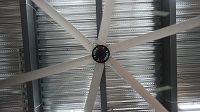
Most people assume a fan motor earns its keep by spinning fast, but the real work happens at low RPM. When the rotor barely moves, the motor has to overcome static friction and the inertia of the blades and air column. This is where torque, not speed, determines whether air starts flowing immediately or stalls. A high-torque motor delivers that initial push without needing a high rotational speed, which reduces mechanical stress and keeps the system quieter during startup.
At low RPM, the motor's magnetic field can be shaped to produce strong pulling force on each rotor tooth, rather than relying on momentum. This is especially important in variable-speed exhaust fans or air handlers that spend most of their operating hours below half their rated speed. By maintaining high torque at these low speeds, the motor avoids the inefficiency of a gearbox and keeps a steady air volume even as duct pressure changes.
The practical result is a fan that moves air consistently in situations where a speed-focused design would stall or overheat. Torque-dense motors, such as those using concentrated windings or permanent-magnet rotors, can hold a blade at a near standstill and still generate useful airflow. That means less energy wasted as heat, fewer speed-up cycles, and a longer service life for the bearings.
Energy Bills Drop When You Stop Fighting the Heat With Spot Fans
Placing a few small fans around the room and pointing them directly at yourself feels like a budget-friendly cooling trick, but it rarely lowers the actual temperature. Spot fans only speed up sweat evaporation on your skin, so the relief vanishes the moment you step out of the airflow. Many households end up running two or three of these fans alongside the air conditioner, which quietly pushes the monthly bill higher instead of reducing it.
A smarter approach is to improve airflow across the entire space rather than chasing hot spots. Open windows on opposite sides to create a cross breeze, or install a low-speed ceiling fan that makes the whole room feel about 2 to 3 degrees cooler. Compared with three or four spot fans working independently, a single ceiling fan often draws only half the total wattage while covering a much larger area.
If you still need targeted cooling in one corner, keep the fan within 1.5 meters of your body and set it to oscillate so the air doesn't hit the same patch of skin continuously. At the same time, seal gaps around doors and windows and block direct sunlight with blinds or curtains. Reducing heat gain lets you raise the thermostat by a couple of degrees without losing comfort, and that adjustment alone can make a noticeable dent in your energy bill over the course of a summer.
From Loading Docks to Indoor Arenas: Matching Fan Placement to Occupancy
Loading docks rarely see steady occupancy, so fan placement there often ignores broad coverage in favor of targeted air movement near truck bays and sorting lanes. Mounting a few high-volume, low-speed fans above the dock edges can push heat out through open doors in summer and destratify warm air near the ceiling in winter, but only if they are spaced to match the dock door count and typical forklift paths.
Indoor arenas flip that logic. A concert or sporting event packs thousands of people into one volume for hours, and the occupants themselves become the main heat source. Here, fan placement follows the seating bowl and the upper concourse, with multiple smaller-diameter units installed in rings rather than a few large ones centered over the floor. This avoids dead zones behind structural beams and ensures air reaches both the upper deck and the floor without blasting the playing surface.
Between these extremes sit warehouses, distribution hubs, and gymnasiums, where occupancy shifts by shift or by event. Matching fan placement to occupancy means looking at when and where people actually gather, not just the building's total square footage—otherwise the result is cooling empty aisles while the busiest lanes stay stagnant.
Ceiling Obstacles? Custom Brackets and Controls That Adapt
When a beam cuts across the mounting plane or a soffit leaves only a shallow void, fixed-length hardware pushes you into a corner. The usual move is to shift the entire layout a few inches, which can ruin sightlines or force you to accept a tilted fixture. Custom brackets change that equation. They let you keep the original position and clear the obstruction with a kink, a deeper flange, or a fully bespoke plate.
A bracket that adapts works best when it's not just milled to size but also adjustable after the fact. Slotted holes give you maybe three quarters of an inch of lateral play; a gusseted arm can carry a load off-center without sagging. And it's not only metalwork. Controls often need to adapt too - a driver moved to the side, a sensor angled past a bulkhead, or a receiver tucked behind a duct - so the obstruction disappears without losing range or response.
The payoff shows at close range. No visible hacks, no long threaded rods fighting a slope, no wiring stretched over a corner. Service is straightforward because the bracket can be removed without pulling the whole assembly down. And if the space changes later, you have a mount that can be re-tensioned or re-angled instead of replaced.
What a Decade of Continuous Use Does to Blade and Bearing Design
Ten years of nonstop operation leaves a mark that no accelerated test can fully replicate. Blade leading edges erode from rain, dust, and salt spray, while bearing raceways develop micropitting and fretting corrosion at the contact lines. Lubricant breaks down into varnish and sludge, starving rollers of the film they need. The result isn't a single dramatic failure but a slow shift in vibration signature and clearance that changes how designers think about fatigue life.
That accumulated wear pushes new designs toward harder coatings, better seals, and self-lubricating cages. Bearings get custom profiles to spread contact stress instead of relying on off-the-shelf geometry. Blade surfaces receive polyurethane or ceramic layers to resist erosion, and root bushings are reworked to handle cyclic pitch loads without loosening. Real load histories replace idealized duty cycles, so fatigue calculations reflect what a decade actually does to the metal.
Serviceability also changes. After years of field repairs, modular blade tips and split bearing housings become standard because replacements can happen up-tower without a full teardown. Condition monitoring moves from add-on sensors to embedded strain gauges and oil debris counters that track wear before it becomes a problem. The lesson from ten years of continuous use is that design must account for degradation as a normal operating state, not an edge case.
FAQ
The sheer blade span moves a tremendous volume of air at low speed, so you get cooling across a wide area without the harsh draft or noise you'd expect from high-velocity units. That combination of coverage, comfort, and quiet operation is the core of our design.
Warehouses, manufacturing plants, gymnasiums, agricultural buildings, and even outdoor covered areas. Any large space with high ceilings or heat stratification sees immediate improvements in air circulation and worker comfort.
By gently mixing the air from ceiling to floor, it reduces the load on HVAC systems. In cooler months, destratification pushes warm air down, and in summer the airflow creates a wind-chill effect that can make the space feel several degrees cooler.
Not at all. Most installations are completed within a day by a certified team, and the direct-drive motor means there are no gearboxes or belts to service. Routine maintenance is mostly just visual inspections and occasional cleaning.
Yes, every unit comes with a variable frequency drive or smart controller, so you can dial in the exact airflow needed. Some customers even automate speed changes based on temperature sensors or time of day.
We back the 7.3M Giant Fans with a comprehensive warranty on the motor and structure, plus lifetime technical support. Our engineers can also help with layout planning and airflow simulations before purchase.
With the right protective coatings and sealed components, it can handle covered outdoor areas like patios, pavilions, and loading docks. For fully exposed installations, we offer weather-resistant upgrades.
Conclusion
7.3M Giant Fans Company has redefined large-space cooling not by spinning faster but by moving air more intelligently. The seven-meter blade span creates airflow patterns that smaller units simply cannot generate, covering broad zones with a gentle, floor-reaching breeze. Instead of relying on high RPM, the motor applies high torque at low speed, keeping air circulating efficiently without the noise or energy spike of smaller, high-velocity fans. Operators who once lined up spot fans to fight heat now see energy bills fall because one properly placed 7.3-meter fan does the work of many, reducing the need for multiple portable units.
Placement matters as much as the hardware. From loading docks with constantly shifting occupancy to indoor arenas hosting thousands, the company matches fan position and mounting to how people actually use the space. Where ceiling obstacles exist—beams, ducts, lighting—custom brackets and adaptive controls ensure the fan still delivers even airflow without compromise. And because these systems are built for decades of continuous use, blade and bearing design have been refined through long-term testing: blades resist fatigue and bearings hold up under constant low-speed load, meaning a 7.3M fan is not just an installation but a long-term airflow asset.
Contact Us
Contact Person: Michael Danielsson
Email: [email protected]
Tel/WhatsApp: +1 951 565 7769
Website: https://www.vindusfans.com