

Best Stainless Steel Self Tapping Screws for Strong and Reliable Fastening
2026-11-16
If you've ever had a screw strip out mid-install or rust after one season outdoors, you know not all stainless steel self tapping screws are equal. The difference between a frustrating redo and a rock-solid hold often comes down to thread design, material grade, and manufacturing consistency. That’s where Wanluo stands out. Built for strong, reliable fastening in metal, wood, and composite materials, Wanluo’s self tapping screws are engineered to bite clean, hold tight, and resist corrosion long after the job is done. Here’s what to look for—and why Wanluo should be on your short list.
Why Stainless Steel Screws Outlast the Job They’re In
Stainless steel screws don't just survive the elements—they actively resist them. The chromium in the alloy forms a microscopic oxide layer that heals itself when scratched, so even after years of rain, salt spray, or chemical runoff, the screw's threading stays sharp and intact. Meanwhile, the wood, sheet metal, or plastic it's driven into often swells, corrodes, or cracks long before the fastener gives up.
Most common screws are zinc-plated or coated, and once that thin barrier wears away, the base steel rusts rapidly. Stainless steel doesn't rely on a surface treatment; its corrosion resistance runs through the entire material. That's why you can pull a stainless screw out of a rotted fence post, wipe it clean, and drive it into a new project without losing holding power. The surrounding material fails first, not the fastener.
Temperature swings and UV exposure also take a toll on many construction materials, causing them to become brittle or warp. Stainless steel maintains its mechanical properties across a wide range of conditions, so it won't loosen from thermal expansion or degrade under harsh sunlight. When you choose stainless screws, you're not just buying a fastener—you're buying a component that will outlive the very job it was meant to hold together.
The Self-Tapping Point That Bites Without a Pilot Hole
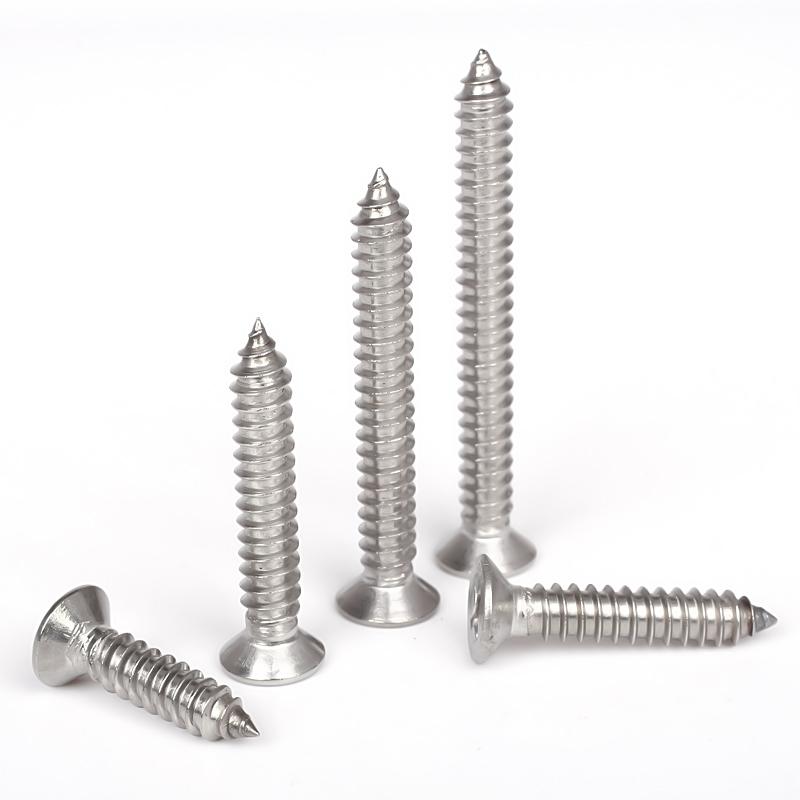
Most self-tapping fasteners demand a pre-drilled hole to guide the thread, but this design skips that step entirely. The point itself is shaped to bite into the material on first contact, carving its own path as it rotates. No center punch, no pilot bit—just direct engagement from the very first turn.
What makes this possible is a combination of sharp geometry and aggressive thread lead. The tip doesn't just press; it scrapes and wedges, splitting the surface fibers or displacing metal enough to establish a full thread profile without stripping. That means faster assembly in wood, thin sheet metal, or even some plastics where a pilot hole would otherwise cause cracking.
You'll appreciate it most in tight spaces or overhead work, where handling a separate drill bit is a hassle. The self-guiding point also reduces the chance of wandering, so the screw seats exactly where you want it. Just keep the RPM steady and let the tip do the chewing—it's more than capable of starting its own hole.
Corrosion Resistance You Can’t Fake in Salt Air
Salt air doesn’t negotiate. A product either holds up after a few seasons of morning fog and onshore wind, or it starts showing rust blooms in the welds and under bolt heads. That’s where most “marine-grade” marketing falls apart. True corrosion resistance isn’t a buzzword you slap on a spec sheet; it’s a chain of decisions—alloy selection, passivation baths, coating thickness, and the discipline to avoid mixing metals that set up galvanic cells.
A standard salt spray chamber test can be passed by parts that still corrode quickly outdoors. The difference shows up in cyclic testing that alternates salt fog, humidity, UV exposure, and drying, or better yet, in years of actual coastal use. Look for 316L stainless with proper low-carbon control, or duplex alloys if strength matters. But even good material fails if the surface prep skips pickling or if threads are cut after passivation, exposing raw steel. Those are the seams where salt air creeps in.
What can’t be faked is the long game: hinges that still swing without creaking after five winters, fasteners that don’t bleed rust streaks down a white fiberglass panel, and no pitting under washers. If a manufacturer can’t show you close-up photos of their product after real deployment—not just fresh out of the box—treat the corrosion claims as unproven. Genuine resistance leaves a trail of maintenance logs and warranty records, not just a shiny finish at the point of sale.
Balancing Hardness and Ductility to Avoid Snapping
Finding the sweet spot between hardness and ductility is more art than formula. A blade hardened to Rockwell 62 may hold an edge beautifully, but drop it on concrete and it shatters like glass. That's because high hardness usually comes from martensitic microstructures riddled with internal stress, leaving little room for plastic deformation before fracture. Tempering pulls some of that hardness back—maybe down to 58 or 59—but buys back enough toughness that the steel bends slightly instead of snapping. The trick is knowing which sacrifices are acceptable for the intended use.
Alloying and heat treatment offer ways to shift the balance without guessing. Small additions of nickel or manganese can lower the ductile-to-brittle transition temperature, making a part less likely to fail suddenly in cold environments. Austempering, where steel is quenched into a hot bath and held, produces bainite—a microstructure that often delivers higher ductility at similar hardness levels compared to untempered martensite. The same principle applies to non-ferrous alloys: over-aging an aluminum alloy trades a few points of tensile strength for a much larger increase in elongation.
Under cyclic or impact loading, the penalty for ignoring ductility becomes obvious. A very hard surface may resist wear but acts as a notch-sensitive layer; any scratch or machining mark can concentrate stress and start a crack that propagates with little warning. Ductile materials blunt the crack tip through local yielding, slowing propagation and sometimes stopping it altogether. In practice, many snapped shafts or broken dies could have been saved by specifying a slightly softer core with a hardened case, or by accepting a hardness range of 55-58 instead of pushing for 60+.
Matching Thread Angle to Sheet Metal Thickness
Thin sheet metal changes the rules for thread selection. A standard 60° thread profile often needs more material than a 0.8 mm or 1.0 mm panel can provide, which leads to weak engagement or stripping under load. Reducing the included angle to something closer to 30° or 45° lets the thread bite into the edge of the punched hole without demanding a full profile depth. This is why many sheet metal screws carry a sharper flank angle than a typical machine screw.
Once the material gets past roughly 1.5 mm, the trade-off shifts. At that point the panel can support a larger thread cross-section, so moving toward a 60° angle gives better shear resistance and a more stable thread form. But the angle alone is not enough. The pitch must also be fine enough to place more than one full thread inside the sheet thickness; otherwise the fastener can tilt or pull through before the thread ever reaches its working load.
In practice, matching angle to thickness means testing the assembly, not just reading a chart. A 45° thread that holds well in 1.2 mm galvanized steel may chew through a softer 0.6 mm aluminum sheet. The goal is to keep the thread flanks engaged without cracking the surrounding material, which usually means starting with a narrower angle for thin stock and widening only when the thickness gives you room for a proper 60° profile.
Installation Habits That Keep Fasteners Tight for Years
Most loosening failures aren't caused by bad hardware—they start with how the fastener goes in. A common habit that separates reliable assemblies from constant re-tightening is cleaning the threads before installation. Old lubricant, metal shavings, or even a bit of rust can create false torque readings. When the wrench clicks at the right number but the joint isn't actually clamped, vibration finds that hidden gap in weeks. Wiping both internal and external threads with a clean rag, then applying a thin, even coat of the specified lubricant or threadlocker, gives a consistent preload that stays put.
Another habit that pays off over time is using the right pattern and reaching torque in stages. Whether it's a wheel hub or an engine cover, alternating between opposite bolts in a star or crisscross sequence prevents uneven clamping and distortion. Instead of pulling each bolt straight to full torque, bring all fasteners to roughly half the target, then repeat at three-quarters, and finish with a final pass. This slow, staged approach lets the mating surfaces settle evenly. If you skip it, one side bites early and the other stays slightly loose—even though the wrench says every bolt is tight.
The last habit is often the easiest to overlook: marking and checking after the first thermal cycle or load. A quick paint dot across the bolt head and the adjacent surface creates a visual reference. After the machine runs hot, cools down, or takes its first real shock, a glance at those marks shows if anything has rotated. Retorquing warm—or at least after the assembly has settled—catches the microscopic embedment that happens as surfaces wear into each other. Pairing that with a consistent storage routine for your torque wrench (wound down to the lowest setting, never used as a breaker bar) means the tool itself isn't fooling you into a false sense of tightness.
FAQ
They resist rust and corrosion far longer, especially in damp or coastal environments, so the fastening stays strong without ugly staining or seizing up over time.
They work best in softer metals, plastics, and wood. For hard materials you usually need a pilot hole or screws specifically designed for metal-to-metal fastening with a cutting tip.
Look for fine threads with a sharp point. Coarse threads tend to strip in thin material, while fine threads grab more edges and hold tighter without cracking the sheet.
410 is harder and stronger but less corrosion resistant, so it suits indoor or mild conditions. 304 offers better rust protection and is usually the safer all-round pick for outdoor use.
In softwood you can often drive them directly without a pilot hole. In hardwood, a small pilot hole prevents splitting and reduces the chance of snapping the screw under torque.
That coating reduces friction during installation. Stainless steel can gall or bind against itself or other metals, so the coating helps the screw cut smoothly and prevents the head from breaking.
Yes, screws with a blunt tip or thread-cutting design made for plastics create less stress. Look for ones with a narrower shank and spaced threads to avoid splitting brittle plastics.
Use a lower speed on your drill, apply steady pressure, and match the bit size exactly. If you feel the screw binding, back it out and add a drop of cutting fluid or use a pilot hole.
Conclusion
When it comes to fastening that must endure, stainless steel self tapping screws earn their reputation by refusing to quit long after the job is done. The real advantage starts with the alloy itself: a balance of hardness and ductility that lets the threads bite into sheet metal without snapping under torque, even on the third or fourth reuse. Unlike plain carbon steel, these screws shrug off salt air and humid marine environments, so the joint stays sound while cheaper fasteners flake and bleed rust. The self-tapping point is the silent workhorse here — it cuts its own path through thin gauge metal without a pilot hole, saving time and reducing the chance of misalignment. But the best results come when you match the thread angle to the material thickness: fine threads grip tighter in thin stock, while coarser pitches hold better in thicker sections. Pair that with a steady drill speed and a light touch on the clutch, and the screw seats itself flush every time, leaving no stripped holes or wobble.
What separates a reliable fastening job from a callback is often the set of habits you bring to the driver. Pre-drilling is not needed for these self tappers, but deburring the edge before driving prevents the screw from camming out on painted or coated surfaces. Hand-tightening the first few turns by feel lets the point find its own center, then power through with moderate pressure — too much force and you risk work-hardening the stainless, which leads to a snapped tip. For outdoor or coastal projects, skip the zinc-plated options and choose a true 304 or 316 grade; the difference shows in five years when the surrounding metal is still bright. Store leftovers in a dry bin with their original thread coating intact, because even the best stainless benefits from a clean start. These small steps, repeated across every panel and bracket, are what keep fasteners tight for years instead of months — and make the phrase "strong and reliable" mean something more than marketing copy.
Contact Us
Contact Person: Shane
Email: [email protected]
Tel/WhatsApp: 8613357785029
Website: https://www.wanluohardware.com