

BOPP Masterbatch Original Manufacturer for High-Performance Films
2026-08-16
Ever wondered why some BOPP films deliver flawless clarity and strength while others fall short? The secret often lies in the masterbatch—and in the hands of the original manufacturer. At Xinwancai, we don't just supply BOPP masterbatch; we engineer it for high-performance films that push the boundaries of durability, optics, and processability. In this post, we'll pull back the curtain on what sets a true original manufacturer apart and why your next film project deserves more than a generic off-the-shelf solution.
Inside Our BOPP Masterbatch Compounding Line
Step onto the floor where our BOPP masterbatch comes to life, and you'll notice the difference immediately. The line isn't a single machine but a carefully sequenced series of stations, each tuned to handle high-load pigments and fragile film-grade carriers without shearing them apart. We feed raw resin and pigment through a side-stuffer that meters exactly what the screw can take, avoiding the surging and uneven dispersion you get when everything is dumped in at once.
The twin-screw section runs shorter and cooler than typical compounding setups. That's intentional, because BOPP film demands masterbatch that won't introduce gel specks or degrade the polypropylene's clarity. Our operators watch melt pressure and temperature curves on old analog gauges alongside newer digital readouts, making small adjustments on the fly. You won't see a control room full of engineers; you'll see two or three people with clipboards and a torque wrench, checking barrel segments and swapping screen packs when the back-pressure tells them to.
After the die face cutter, pellets drop into a counter-flow water bath that strips away surface fines before they reach the classifier. We run every batch through a 400-micron screen and then a magnet trap, even though the resin supplier swears it's clean. It's slow, but nobody here wants to explain a bubble break during a customer's trial run. The line ends at a bagging station where we nitrogen-flush the sacks, not for marketing reasons, but because some of our carbon black grades will clump if left to breathe in humid air.
How Carrier Resin Selection Affects Film Clarity
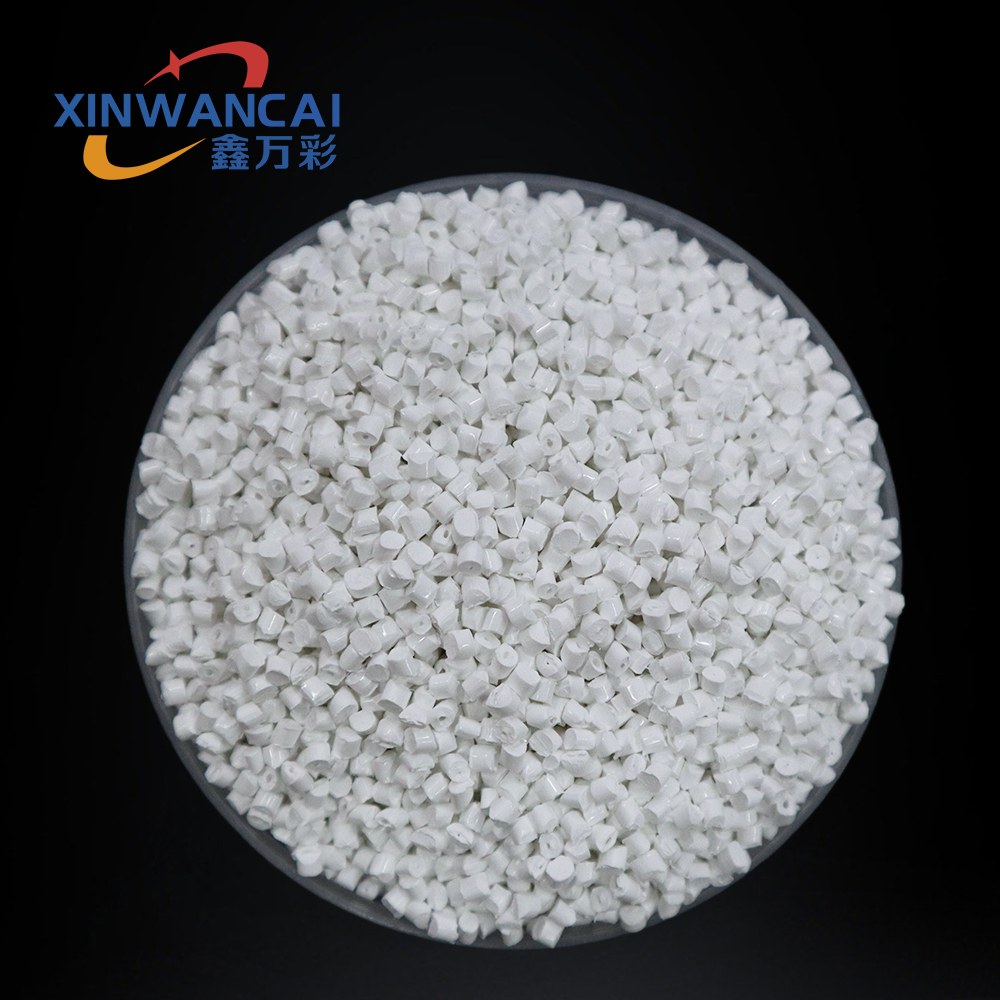
The base polymer you choose to carry pigments or additives into a film plays a far bigger role in final clarity than most processors expect. If the carrier resin has a melt flow index substantially different from the host film resin, it can create localized viscosity mismatches during extrusion. These mismatches disrupt the laminar flow path, leaving tiny streak-like inclusions that scatter light even when the additive itself is fully transparent. Matching the melt flow within a narrow range often clears up haze that no amount of screw speed adjustment will fix.
Refractive index alignment between the carrier and the main polymer is another quiet contributor to optical quality. When the two resins differ by even a few hundredths in refractive index, each microdomain of carrier becomes a lens that bends light slightly off-axis. In multilayer films or thin gauge structures, this effect compounds rapidly, turning an otherwise glass-clear web into something with a milky or pearlescent cast. Selecting a carrier with nearly identical optical density to the host material eliminates this internal scattering without requiring additional compatibilizers.
Compatibility at the molecular level matters just as much as bulk properties. A carrier resin that is chemically similar to the film polymer will interdiffuse during melting, forming a continuous phase rather than discrete pockets. This leads to uniform additive distribution and lets the film retain its native transparency. On the other hand, an incompatible carrier may survive as separate islands, each acting as a stress concentrator and light scatterer. In practice, choosing a carrier from the same polymer family as the film—or a well-proven grafted variant—often delivers the clearest result with the least formulation trial-and-error.
Balancing Additive Loads for High-Speed BOPP Lines
On a high-speed BOPP line, additive load balancing is rarely a set-and-forget task. A masterbatch ratio tuned for 300 m/min often drifts out of spec by the time the line reaches 450 m/min, not because the chemistry fails but because the thermal and shear history changes faster than the additives can redistribute. Slipping agents may bloom too early, leaving deposits on the MDO rolls, while antiblock particles settle unevenly in the melt, creating optical defects after transverse stretching.
Speed increases shorten residence time in the extruder and raise melt temperature by several degrees, so low-molecular-weight additives migrate toward the surface more aggressively. In that window, the practical move is to lower the slip load slightly while raising the antiblock or antistatic share only if downstream winding and corona treatment data justify it. This keeps the film from becoming hazy or losing consistent coefficient of friction.
Balancing also means tracking the additive package against line speed in small steps. A staged ramp with friction, haze, seal strength, and die build-up checks at each plateau reveals which components tolerate higher rates and which need trimming. Over time, those data points form a speed-dependent loading curve specific to the resin and film grade, avoiding the old habit of scaling every additive by the same percentage.
The Dispersion Quality Behind Stronger, Clearer Films
A film's mechanical strength and optical clarity rarely trace back to the resin alone. The real differentiator sits in how well solid particles are separated and stabilized during wetting and milling. When pigment agglomerates break down into primary particles and remain suspended without re-flocculating, the cured matrix distributes stress more evenly. Micro-cracks that would otherwise start at large clusters never get the chance to form, which translates directly into higher tensile and tear resistance.
Poor dispersion often looks like a formulation problem on the surface, but it usually reveals itself in subtle ways first. Haze increases even when total light transmission stays high, because sub-micron aggregates scatter blue wavelengths more aggressively. Film clarity drops before any visible grit appears. The same aggregates also create weak boundary layers around each particle, where resin wetting is incomplete. Under flex or impact, these boundaries fail first, turning an otherwise tough film brittle at the most inconvenient moments.
Achieving clean dispersion is less about adding more dispersant and more about matching the additive package to the pigment surface chemistry and the shear profile of the mill. Over-dispersing can be just as harmful as under-dispersing, since excessively fine particles increase total surface area beyond what the binder can wet. The best film formers tune the process until a drawdown shows no seediness under a 25x loupe and a haze meter reads below half a percent. That balance is where strength and clarity meet without sacrificing either.
Batch-to-Batch Consistency Checks We Run Every Shift
At the start of every shift, we pull three finished lots from the previous shift's quarantine shelf and set them beside the first batch we're about to release. The comparison isn't just a quick glance at color. We use a standard light booth to check clarity, surface gloss, and any sign of micro-particles or separation. Viscosity and density are measured twice each, averaged, and if any value drifts more than 1.5% from the reference lots, the line stops before a single unit gets filled.
Beyond physical properties, we run a rapid fill simulation. Ten samples are filled with the current batch, then weighed for net content, checked for cap torque, and tested for drop-out volume. Those numbers go into a shift handover log that tracks every batch from the past 72 hours. If we see two consecutive batches with steadily lower torque, even if both are within spec, we adjust the capping station before it becomes a real defect.
We don't wait for failures to show up in a lab report. Every four hours, a different operator repeats the core checks to avoid habitual bias. Retained samples are kept in a cool cabinet for at least 14 days so any customer feedback can be traced back to the exact shift and batch. It's a slow, manual process, but it keeps variation so small that users can't feel the difference between one bottle and the next.
Co-Developing Custom Masterbatch with Film Producers
Custom masterbatch development works best when film producers are part of the conversation long before a final spec is drawn up. Things like gauge tolerance, slip requirements, and heat-seal behavior vary from one line to another, and a formulation that runs perfectly in a lab can still cause headaches on a production extruder. By sharing actual film samples and processing data early, the masterbatch supplier can adjust carrier resin, pigment loading, or dispersion aids in ways that avoid costly downtime later.
The difference often comes down to the small stuff—whether an anti-block additive leaves a visible speck, how well the color holds at different blow-up ratios, or if the masterbatch feeds smoothly through a hopper without bridging. A supplier that's willing to run pilot trials on similar equipment, then tweak the recipe based on real feedback, is worth far more than one that simply ships a standard product. That kind of back-and-forth turns a custom order into a repeatable formula, and it's the only way to get consistent film reel after reel.
FAQ
We formulate each batch with premium pigments and additives that survive biaxial stretching without breaking down, so film clarity, opacity, and surface finish stay consistent even at high line speeds.
We keep detailed reference samples and use spectrophotometric checks on every lot. Our production records allow us to reproduce the same shade within tight Delta E tolerances, no matter when you reorder.
Yes. We start from your target values, then adjust carrier resin compatibility, additive loading, and particle size to meet properties such as anti-static performance, slip, or low haze without sacrificing processability.
Our products are used in packaging films, label films, lamination films, and specialty films for food, textile, and adhesive tape applications. We can also formulate for matte, pearlized, or high-gloss finishes.
We don't just ship material. Our technical team reviews your line conditions, helps set temperature profiles, and stays available for troubleshooting until the masterbatch runs smoothly and meets your film specs.
We use fine filtration and controlled dispersion during compounding, then test each batch for filter pressure and particle size. This reduces gels and agglomerates that would otherwise show up as film defects.
Most standard colors ship within 7 to 10 working days after order confirmation. Custom developments may take longer depending on testing. Minimum quantities are flexible for trial batches, with volume pricing available for regular production.
BOPP orientation demands a narrow processing window and excellent dispersion. A dedicated manufacturer understands how additives behave under high draw ratios and can avoid issues like plate-out, poor wet-out, or inconsistent down-gauging.
Conclusion
Running a BOPP masterbatch line as the original manufacturer means every lot starts with our own compounding setup, not a toll processor's guesswork. The carrier resin choice is the quiet lever on film clarity—pick a polypropylene grade with too wide a molecular weight spread and you'll see haze creep into even thin-gauge films. We learned to match carrier melt flow to the target BOPP orientation speed, so the masterbatch stretches with the film rather than fighting it. Dispersion quality is where strength and clarity actually come from; we run twin-screw configurations with specific shear profiles and back-pressure settings that break down pigment and slip additive agglomerates without overheating the resin. That balance keeps additive loads efficient enough for high-speed BOPP lines without leaving unmelts or fisheyes.
Every shift we pull samples from the line for batch-to-batch consistency checks—not just melt flow index and ash content, but film draw-down tests on a small cast line to judge haze, gloss, and coefficient of friction under real orientation. If a batch drifts, we quarantine it before it reaches a customer's silo. The real difference from off-the-shelf masterbatch shows in co-development work: when a film producer needs a custom slip package for a 15-micron metallizable film or an anti-block load that won't hurt seal strength, we adjust the carrier, additive ratios, and screw profile together. That back-and-forth produces masterbatch that runs clean on the customer's line from the first trial, which is what high-performance BOPP film actually requires.
Contact Us
Contact Person: JACK
Email: [email protected]
Tel/WhatsApp: 86 18650130917
Website: https://www.xinwancai.com/