

Gearless Flexo Press Factory Advancements for High-Precision Label Production
2026-11-16
Removing gears from a flexo press sounds like a small mechanical change—until you see what it does to label precision. Without gear pitch, backlash, and wear dictating every impression, servo motors take over with repeatability that mechanical systems simply can't match. At the center of this shift is HuiPeng, a factory pushing gearless flexo press advancement beyond the spec sheet. In the sections ahead, we’ll unpack the engineering choices, real-world tolerances, and production-floor advantages that are redefining what high-precision label work actually means.
Servo Precision That Ends Plate Cylinder Guesswork
Traditional plate cylinder alignment on offset presses relied heavily on operator instinct and manual measurements. Every job change meant trial pulls, incremental adjustments, and wasted sheets before achieving acceptable registration. That guesswork is now obsolete thanks to direct servo positioning.
Servo drives equipped with high-resolution encoders feed back exact angular and axial position data in real time. A closed-loop motion controller compares this feedback against the target values entered on the HMI, compensating for mechanical backlash and temperature drift automatically. The result is repeatable positioning within a few microns—no more eyeballing or marking cylinders by hand.
Operators simply call up a saved job profile or input the required offset, and the servo moves the plate cylinder to the commanded position, locks it, and confirms via the interface. This precision keeps register stable across varying press speeds and reduces makeready time significantly. The skill of the press crew shifts from guesswork to process control, delivering consistent output even on short runs.
What Changed in the Pressroom When Gears Went Away
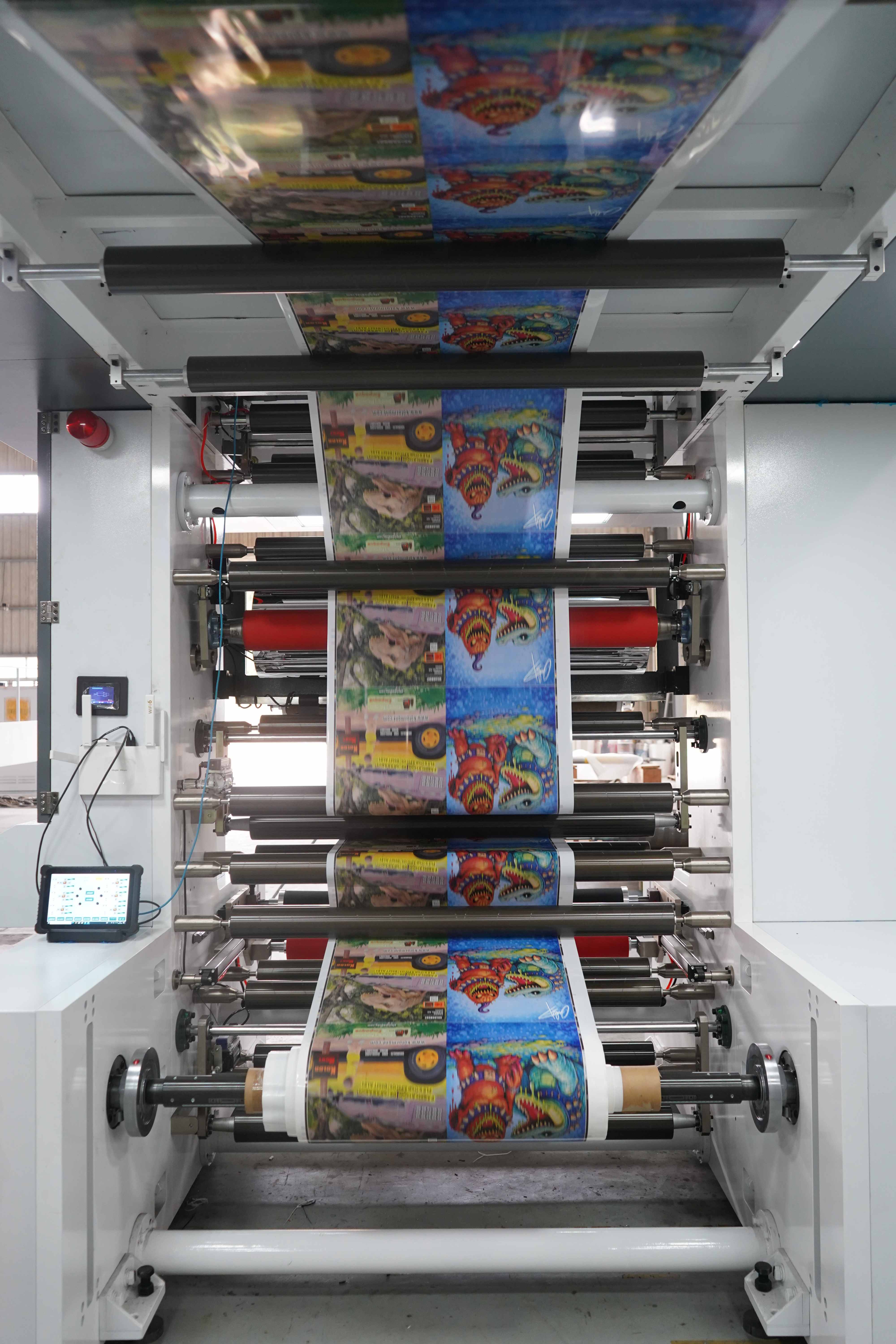
The first thing you noticed was the quiet. Without gear trains meshing and lashing, the pressroom lost that constant metallic grind. Operators who'd spent years shouting over the noise suddenly found themselves talking in normal voices. The floor stayed cleaner too—no more oil flung from gear housings, no more wiping down guards between shifts.
Maintenance routines shifted in ways nobody fully anticipated. Instead of checking tooth wear or replacing timing gears on a schedule, crews began pulling up drive diagnostics on laptops. A servo motor's error log told you more than a stethoscope ever could. That said, it wasn't all easier. When something did fail, it usually meant calling a specialist rather than grabbing a wrench.
Print quality improved in subtle but real ways. Without mechanical backlash, registration held tighter through acceleration and deceleration. Waste dropped on every makeready, and the press could jog back and forth without the old "bump" that used to knock plates out of fit. Long runs stayed more consistent too, because there were fewer parts wearing down and changing the geometry.
The Hidden Engineering Behind Micro-Dot Label Clarity
The crisp edges of a micro-dot label rarely come from print resolution alone. Before a single droplet lands, the substrate surface is tuned through corona or plasma treatment so that its surface energy sits in a narrow band. Too low and the ink beads up, shrinking the dot below the readable threshold; too high and the ink spreads outward, creating feathered borders that blur adjacent data points. Engineers watch contact angle measurements the way others watch temperature gauges, because a shift of a few degrees can turn a clean 50-micron dot into an unreadable smear.
Beneath the visible dot lies an optical stack that rarely gets attention. Many micro-dot systems are read under infrared or ultraviolet light, which means the pigment or dye must absorb strongly at the detection wavelength while staying nearly invisible in daylight. This is not a single-coat problem. A dark underlayer kills substrate reflection, a spacer layer controls interference, and the top coat is adjusted for gloss so the dot does not flash when a handheld scanner tilts off-axis. Each layer changes how light enters and exits the dot, and getting the balance wrong can make a perfectly printed dot disappear in the reader.
The last piece is often the least glamorous: thermal drift inside the printhead. A micro-dot label may contain thousands of dots, each expected to stay within a few microns of its nominal size. Piezoelectric nozzles fire millions of droplets during a single run, and as they warm up, ink viscosity drops. Without active compensation, dots grow from start to finish. Closed-loop systems measure droplet velocity or volume on the fly and reshape the drive waveform, essentially re-tuning the printhead hundreds of times per second to keep every dot inside the tolerance window that the reader demands.
Setup Times That No Longer Dictate Label Profit Margins
Historically, label converters treated press setup as a fixed cost that had to be amortized over long runs. That logic forced shops to chase volume and turn away smaller jobs, because every minute spent mounting plates or dialing in registration ate directly into margin. Today that equation has flipped. Modern presses with servo-driven automation, quick-change die stations, and digital workflows routinely complete changeovers in minutes rather than hours. The result is that setup time no longer functions as the hard gatekeeper of profitability; a short-run label job can carry the same healthy margin as a long one.
The shift goes beyond hardware. Many label operations now use job nesting, pre-loaded substrates, and standardized tooling to strip out variability before a job ever reaches the floor. Operators spend less time adjusting and more time monitoring quality, which changes how labor costs are absorbed. In this environment, profit margin is driven less by how long it takes to get ready and more by how accurately you price materials, how well you manage ink coverage, and how reliably you hit delivery windows. Setup is just another controllable variable, not the anchor it used to be.
How Modern Factories Tackle Substrate Variability Without Manual Tweaks
In the past, a slight shift in substrate thickness or surface roughness would send technicians scrambling to adjust roller pressures, drying temperatures, and coating speeds. Today, that reactive loop has been replaced by a tight integration of in-line sensors and adaptive control algorithms. Laser profilometers and near-infrared moisture meters feed real-time data into a central process controller, which compares each incoming sheet against a stored tolerance envelope. When variability is detected, the system automatically nudges actuator settings—often within milliseconds—without an operator ever touching a dial. The result is a line that corrects itself mid-run, keeping output within spec even as raw material batches drift.
What makes this possible is not just the sensors, but the way modern factories pre-characterize raw materials long before they reach the coating or laminating stage. Incoming substrates are scanned and classified into discrete profiles based on density, moisture content, and surface energy. These profiles are then used to pre-load machine parameters—such as gap heights, tension setpoints, and cure dwell times—so that each roll or sheet enters the line with a customized recipe already in place. This “front-loaded” approach removes the need for manual trial-and-error adjustments, because the variability has been quantified and compensated for before the substrate ever hits the first process station.
Even when unexpected extremes occur—such as a sudden change in ambient humidity or a substrate lot with abnormal porosity—the system relies on closed-loop feedback that learns from past corrections. Historical data from similar events is mined to predict the most effective combination of adjustments, and the controller cycles through them in a prioritized order until process outputs return to centerline. This self-correcting behavior allows a single operator to oversee multiple lines simultaneously, shifting the human role from constant knob-turning to exception monitoring and long-term process optimization.
From Short Runs to Long Runs: The New Economics of Gearless Flexo
Gearless flexo presses used to be pigeonholed as short-run specialists. Rapid sleeve swaps and reduced makeready waste made them the obvious choice when job lengths hovered in the low thousands. But that reputation has started to fray. Modern servo-driven decks, tougher elastomer sleeves, and closed-loop registration have pushed the cost crossover point much further out. A run that once looked marginal at 8,000 impressions now stays profitable past 100,000 because the old penalties—gear marking, repeat length constraints, long changeovers—don't bite the way they used to.
The shift comes down to a few quiet economic changes. Sleeve storage costs have dropped while laser-engraved sleeves survive far more impressions than the photopolymer plates they replaced. Presses without gears no longer fight barring or backlash at higher speeds, so long-run quality stays flat instead of degrading. Meanwhile, changing repeat length no longer means swapping gears or buying a dedicated press. A single machine can move from a narrow snack wrapper to a wider pet food bag with a sleeve change and a parameter download. That flexibility changes how converters assign machine-hour costs.
None of this suggests every long run belongs on a gearless press. Some commodity jobs with stable repeat lengths still favor geared lines that cost less per station. But the gap has narrowed enough that many converters now treat gearless as the default, not the exception, especially when floor space is tight and the job mix swings from short to long without warning. In that light, the new economics aren't about gearless catching up—they're about the old distinctions losing their relevance.
FAQ
Transitioning to individual servo motors on each print deck eliminated gear backlash and mechanical wear points. Combined with automatic pre-registration cameras, the press now hits color-to-color tolerances under 0.05 mm on thin film stocks.
Without physical gears to swap for repeat length changes, operators can load sleeve-based plate cylinders and set repeat lengths digitally in under a minute. Automatic impression and pressure presets based on substrate caliper cut the number of test labels needed before reaching sellable output.
Temperature and humidity are held within tight bands around the print deck. Thermal expansion of polymer plates and adhesive liners is a major cause of registration drift; keeping the production hall at 23°C ±1°C and 50% RH ±5% keeps expansions predictable and compensable.
Yes, but it requires precise web tension control. The factory pairs low-inertia servo rollers with closed-loop tension sensing every few feet. For 12-micron PET, tension is often reduced to under 15 N, and the press adjusts acceleration curves to prevent substrate distortion during rapid job changes.
100% print inspection cameras scan at full press speed with 8K line-scan resolution. Defect detection algorithms are tuned per job, flagging voids, hickeys, and misregistration down to 0.1 mm². Rejected labels are automatically marked and logged, allowing the operator to review only true anomalies rather than sampling by hand.
Maintenance shifts from gearbox rebuilds and backlash adjustments to firmware updates and bearing health monitoring. Vibration sensors on each servo motor detect early bearing wear, and annual alignment checks on the sleeve mandrels are usually sufficient. The result is less unplanned downtime and longer intervals between mechanical overhauls.
High-density barcodes, micro-text security labels, and multi-layer coupon constructions gain the most. Since gearless presses hold registration consistently at high speeds, brands can run smaller QR codes and finer line work without sacrificing scan reliability on retail shelves.
Conclusion
The shift to gearless flexo presses has quietly rewritten the rules inside label converting plants. Removing the gear train eliminates the accumulated backlash and mechanical chatter that once forced operators to compensate for plate cylinder position drift. Servo drives now hold each print station in exact register, so makeready no longer involves trial-and-error adjustments to chase ghosting or misregistration. In practice, a job that used to burn an hour on fine-tuning can often be approved after a handful of impressions. The hidden payoff shows up in micro-dot reproduction: without gear-induced vibration, screens and fine text hold their shape, letting designers specify smaller type and tighter vignettes without worrying about press artifacts. Operators stop treating substrate changes as disruptions because the press adjusts impression and tension per station automatically, absorbing variations in caliper, surface energy, and roll memory that would previously demand manual intervention.
That stability changes the economics of label production, not just the technical output. Short-run work no longer carries a punishing setup penalty, so converters can accept smaller orders without sacrificing margin. Long runs become more predictable because the press does not drift out of register as components warm up or wear. Factories can standardize on fewer operator interventions, which reduces training burden and allows one press crew to manage more ambitious schedules. The result is a pressroom where profitability depends less on guesswork and more on repeatable, servo-controlled precision. In many plants, the switch to gearless flexo has shifted conversations from how long will this take to set up to which jobs can we combine tonight, a practical sign that high-precision label production is no longer reserved for niche, high-margin runs.
Contact Us
Contact Person: Isaias
Email: [email protected]
Tel/WhatsApp: 86-13868693129
Website: https://www.hpflexo.com/