

OEM Swim Fins How to Pick the Right Pair for Your Swim Style
2026-09-25
Not all swim fins are created equal—what works for a relaxed breaststroke might feel like dragging anchors during a fast flutter kick. If you're exploring OEM options to match your unique swim style, OCORT offers a range worth a closer look. This guide breaks down key factors like blade length, foot pocket fit, and stiffness so you can skip the trial-and-error mess and get the right pair from the start.
Let Your Kick Decide the Blade Shape
Most swimmers never think about how their kick influences the fin they should be wearing. A soft, fluttery kick from the hips pairs naturally with a shorter, more flexible blade that snaps back with each cycle. Force a stiff, oversized blade onto that same swimmer and you’ll see wasted energy, cramping calves, and a fin that feels like dead weight.
On the other hand, a powerful dolphin kick driven from the core produces long, sweeping undulations. That motion thrives on a longer blade with moderate stiffness—enough surface area to load and release, but not so rigid that it punishes the ankles. The blade becomes an extension of the body’s wave, not a separate paddle fighting the rhythm.
The real insight is that blade shape isn’t about brand loyalty or the deepest discount. It’s about matching the fin’s flex profile and surface area to the speed and amplitude of your kick. Spend a session paying attention to how your legs move before you buy. The right blade will feel less like added equipment and more like a natural amplifier of what you already do.
The Foot Pocket Test Most Swimmers Skip
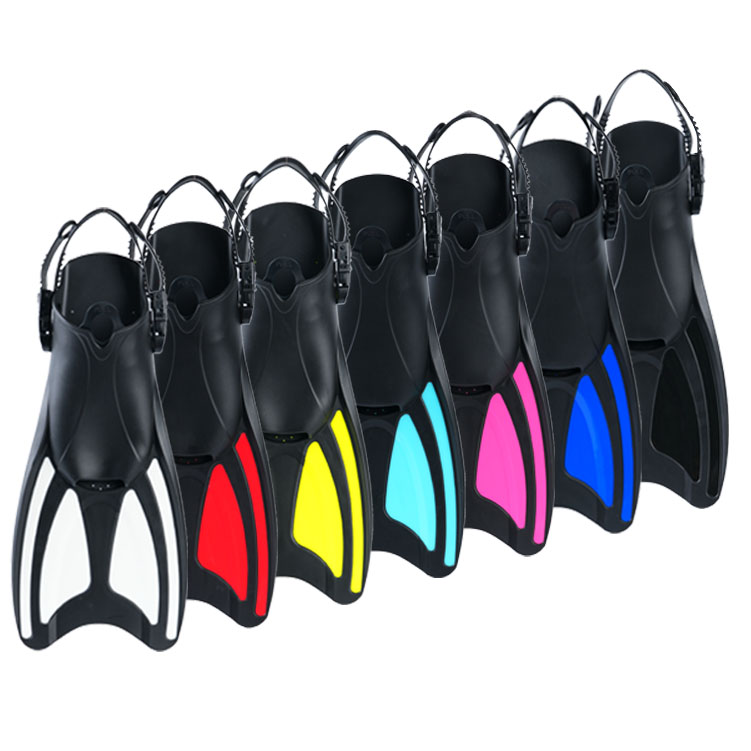
Most swimmers treat fin fit like a shoe size—slide it on, wiggle the toes, call it good. That misses the real variable: how the foot pocket deforms during a kick. A pocket that feels snug on the pool deck can still buckle or fold mid-stroke, bleeding power before it ever reaches the blade. The test you're skipping takes about twenty seconds and doesn't require water.
With the fin on, plant your heel against the ground and drive your knee forward until the ball of your foot is loaded, as if you're finishing a kick. Watch the sidewalls. If they cave inward enough to touch your foot, or if the top edge rolls down, you're losing surface area and getting zero snap back. That's the difference between a fin that helps and one you're fighting.
A proper pocket should hold its shape under that load, flexing only at the toe line while the heel stays seated. If yours doesn't, don't just size down—look for a stiffer rubber compound or a pocket with reinforced rails. Skipping this check is why so many swimmers complain about tired ankles and slow dolphin kicks when the fin itself was never working to begin with.
Short or Long? Stroke Speed Holds the Answer
Swimmers often chase a longer stroke, but length alone doesn't make you faster. The real test is what happens to your stroke rate when you stretch out. If a slightly shorter, snappier pull keeps your speed steady or pushes it up, that shorter stroke is the right call.
Stroke speed works like a built-in feedback loop. Count your cycles per minute over a fixed distance, or use a tempo trainer if you have one. Shorten the stroke just enough to lift the rate, then check your time. If the clock drops, you were overreaching. If it climbs, you need more length in the catch and finish.
The sweet spot is where stroke rate and distance per stroke meet without forcing either one. A simple set like 8x50 alternating your normal length with a consciously shorter pull at the same effort will expose what works. Let the stopwatch, not the feel, tell you whether short or long wins for your stroke.
Flex, Stiffness, and the Feel You Can't Ignore
There's a quiet assumption that stiffer always means better—more power, more precision. Spend twenty minutes with a shaft or frame that actually flexes, though, and that assumption starts to crack. The bend isn't a flaw. It's a timing device. It loads up just before impact and releases a fraction of a second later, stretching that moment of contact into something you can read with your hands. Miss it, and everything feels rushed. Find it, and the gear starts talking back in a language that doesn't need words.
Stiffness, on the other hand, has a different kind of honesty. It gives you everything immediately—every vibration, every off-center hit, every ounce of force you put in. There's no delay, no filtering. That can feel sharp and responsive at first, almost addictive. But after an hour, the same directness can turn into fatigue. Your hands start to brace for impact instead of feeling for it. It's the difference between a high-resolution photo and a raw data stream: both accurate, only one you'd want to live with.
The feel you can't ignore is what sits between those two poles. Not the spec sheet number, but how the whole thing behaves when you're tired, when your swing isn't perfect, when the match is on the line. It's why two products with nearly identical stiffness ratings can feel completely different. One filters the noise and keeps the signal. The other just passes everything through. You don't need a lab to tell which is which. Your hands already know—you just have to stop overthinking long enough to listen.
Full Foot vs Open Heel: A 30-Second Fit Check
For full-foot fins, forget the “if it slips on, it fits” myth. Put the fin on barefoot and stand. Your toes should brush the front without curling, and the side rails should feel like a firm handshake, not a clamp. Any gap at the heel when you flex your foot means the fin will pivot and rub on every kick.
Open-heel fins demand a different test since your bootie does the heavy lifting. Wear exactly the boots you’ll dive in, secure the strap loosely, then tighten until you can just fit two fingers between strap and heel. If the buckle digs into your instep or the fin slides side to side when you shake your foot, adjust the strap length—not your boot size.
Spend thirty seconds walking in place and kicking slowly. Hot spots, pinching, or that vague feeling of “I’ll get used to it” are all signs to try another size or model before you hit the water.
When Off-the-Shelf Fins Fall Short, Custom OEM Steps In
Standard fin designs assume a certain set of operating conditions, but real heat exchangers rarely follow the textbook. Once you push past typical temperature ranges, encounter aggressive fluids, or need to fit into a cramped enclosure, those catalog parts start to show their limits. The fin pitch is wrong, the material is too soft, or the mounting holes never line up. At that point, forcing a generic fin to work costs more time and performance than it saves.
Custom OEM fin manufacturing flips the process. Instead of starting with a fixed geometry and hoping it fits, the design begins with your actual thermal load, airflow, and space constraints. Fin height, thickness, spacing, and even the base profile get tuned to match how the heat actually moves through your system. This often unlocks better cooling with fewer compromises—no more adding extra fans or oversized housings just to accommodate an off-the-shelf shape.
The real advantage shows up in production as well. A fin built for your specific assembly drops in without hand trimming or secondary machining. Tolerances are held to your drawing, not a generic datasheet. Over hundreds or thousands of units, that consistency reduces scrap and assembly headaches. When performance and repeatability matter more than the convenience of next-day shipping, custom OEM fins stop being a luxury and become the practical choice.
FAQ
Start with your typical kick rhythm. Short, stiff blades suit quick, compact kicks, while longer, more flexible blades reward a slower, gliding stroke. Match the fin to how your legs already move rather than chasing a brand.
Not necessarily. Longer fins generate more thrust per kick but demand stronger ankles and can tire you quickly. If your sessions run long, a medium-length fin often gives better sustained pace without wrecking your form.
Pay attention to calf strain during the first ten minutes. If you feel burning or cramping early, the blade is fighting you. Softer rubber or silicone fins let you keep a natural flutter kick without overloading the lower legs.
You can, but pool swimmers usually prefer shorter fins for tighter turns and drill work. Open water swimmers often opt for longer blades to cruise against currents. If you split time, pick a mid-length fin with a comfortable foot pocket.
It matters more than most people expect. Soft silicone pockets reduce blisters and pressure points on long swims, while harder rubber pockets can transfer more power but may rub. Try them with wet feet to check for heel slip.
Often yes. Beginners benefit from shorter, softer fins that encourage proper ankle flex without fatigue. Experienced swimmers might use stiffer, longer blades for targeted strength work. Your current leg endurance should guide the choice.
OEM fins are typically made to a buyer's spec, so fit can vary widely. Look for detailed size charts and, if possible, sample pairs. A well-designed OEM fin should match the fit of a name-brand model in the same size range.
Many choose based on looks or maximum blade length. That leads to sore ankles and poor technique. Instead, pick a fin that lets you keep your normal kick tempo for the full session without extra effort.
Conclusion
Choosing the right OEM swim fins starts with how you kick, not what's popular on the rack. A swimmer who drives from the hips with a long, steady beat usually pairs well with a longer, slightly stiffer blade that loads up water on the downstroke. If your flutter kick is fast and compact, a shorter, softer blade won't fight your tempo. Don't skip the foot pocket: slide your foot in and feel whether your heel sits snug without pinching and your toes have a little room at the front. The 30-second full foot versus open heel test comes down to where you train—warm pool and bare feet lean full foot, while cooler water or booties favor an open heel.
Then there's flex and stiffness, which you really only notice after a few hundred meters. Too rigid and the ankles start complaining; too bendy and you lose that satisfying snap on the finish of each kick. The right feel is a blade that recoils just as your leg finishes, helping rather than resisting. When standard shapes, sizes, and stiffness options miss the mark—whether because your club has a specific stroke technique or your foot width is outside the norm—that's where custom OEM makes sense. You can adjust blade angle, rail profile, and pocket dimensions to match how your swimmers actually move through the water. Off-the-shelf fins rarely give you that kind of control.
Contact Us
Contact Person: Wendy
Email: [email protected]
Tel/WhatsApp: 86 18807398467
Website: https://www.zlfswim.com