

Smart Blinds OEM Manufacturing for Custom Automated Window Treatments
2026-08-25
Imagine waking up to sunlight that adjusts itself to your schedule—no manual pulling, no tangled cords. That’s the promise of smart blinds, and behind every seamless automated window treatment is a manufacturing partner who understands precision and customization. At ROLLERGY, we specialize in OEM manufacturing for custom automated window treatments, turning your design concepts into motorized solutions that fit any space. In this post, we’ll explore what makes smart blind OEM manufacturing tick and how the right partner can elevate your product line.
Why Off-the-Shelf Blinds Often Miss the Smart Home Mark
Most store-bought smart blinds still cling to a hub-and-spoke mentality that feels years behind the rest of the modern smart home. Instead of joining your existing Thread or Zigbee mesh, they demand a dedicated bridge, another app, and an account you’ll forget by the time the batteries need charging. That friction alone is enough to make them feel like a side project rather than a natural extension of the room. The worst part? Many of these systems treat “smart” as a synonym for “remote-controlled.” You get a timer and maybe a scene toggle, but little awareness of temperature shifts, occupancy patterns, or the way light actually moves across your floor throughout the day.
A deeper issue is how poorly these products handle the nuance of real routines. A blind that only knows open and close can’t tilt slats to cut glare while keeping the view, nor can it gradually adjust during a movie without being told three times. Off-the-shelf options often default to harsh, full-speed movements that yank the room from bright to cave-like, which defeats the purpose of a comfortable living space. They also tend to ignore the value of local processing—when the cloud goes down or the Wi-Fi blips, you’re left standing by the window, pulling a cord like it’s 1995.
Then there’s the ecosystem mismatch. If your lights, thermostat, and locks all understand “good morning” as a five-minute sunrise, a generic blind product might not even expose the right controls to that routine. You end up layering workarounds—IFTTT recipes, third-party bridges, voice commands with odd syntax—until the “smart” feature becomes another chore. The mark of a truly smart blind isn’t just being controllable from a phone; it’s disappearing into the background and making the room feel right without a second thought. Most off-the-shelf models aren’t there yet, and the gap is more obvious every year.
Inside an OEM Line Built Around Non-Standard Window Shapes
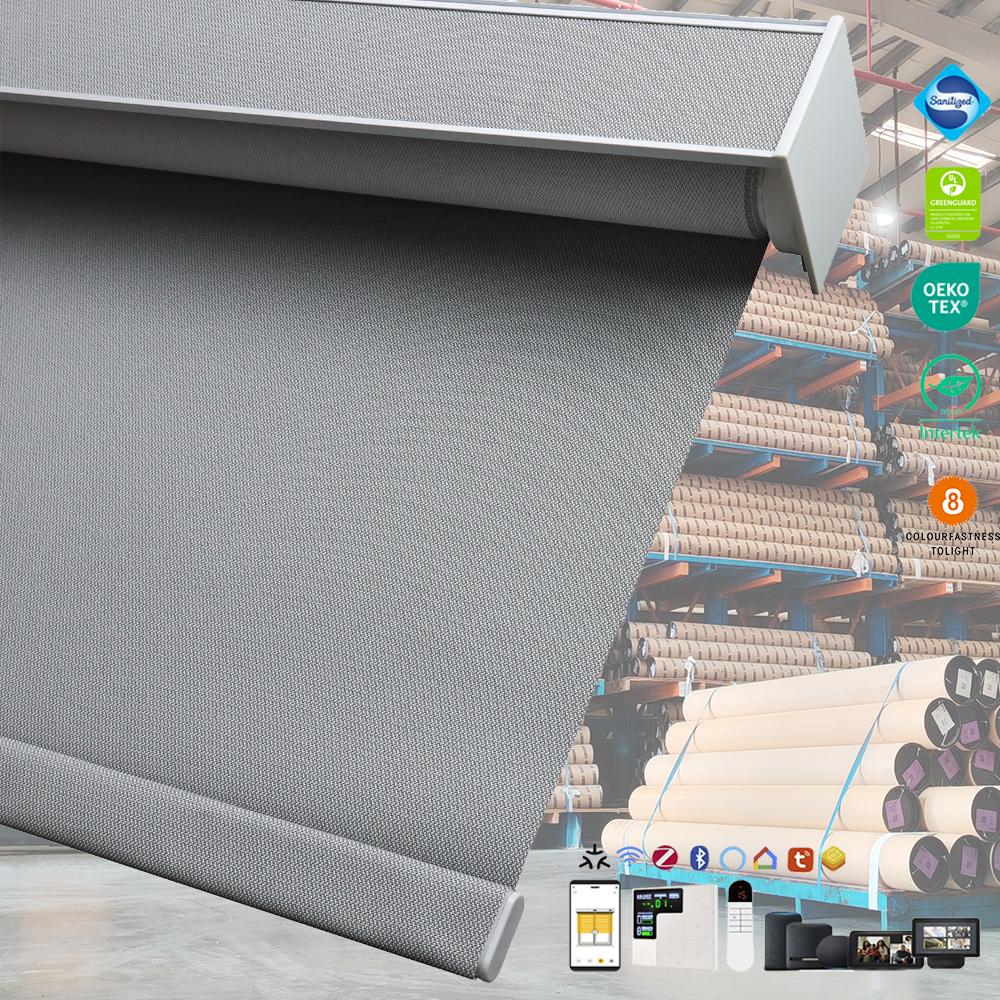
Inside an OEM line built around non-standard window shapes, the first thing you notice is the absence of fixed assembly stations. Workers move between jigs that are reconfigured daily, sometimes hourly, to accommodate arches, trapezoids, and round-tops that don't follow a straight-line path. A typical shift might start with a custom radius window for a Victorian renovation, then pivot to a set of triangular transoms for a new build. The machinery here is not the high-speed automated kind found in commodity window plants; instead, you'll see CNC routers paired with hand-finishing bays, where operators check every curve against a physical template before glass ever enters the frame.
Another defining feature is the role of inventory. Because no two orders are alike, the line doesn't pull from a warehouse of pre-cut vinyl or aluminum profiles. Instead, raw lengths arrive in bulk and are cut to order at the first station, with offcuts saved for smaller components like mullion covers or glazing beads. This just-in-time approach keeps waste down but demands a scheduling system that can handle last-minute change orders without stalling the whole line. Engineers here often joke that the only standard part is the shipping crate.
The human element carries more weight than in standard window production. Sealant application, for instance, is done by hand on non-linear edges where automated nozzles can't maintain a consistent bead. Quality checks happen at multiple points, not just at the end, because a single degree of error on an arch can throw off the entire installation. Crews tend to stay with a window from cutting to crating, which builds a sense of ownership but also requires cross-trained workers who can read shop drawings as fluently as they operate a brake press.
Motor Calibration and the Difference Between Quiet and Invisible
Motor calibration often chases a single number: decibels. But there is a real gap between a motor that measures quiet and one that feels invisible. Quiet is about sound pressure level. Invisible is about perception across every sense. A drive can show 35 dB on paper, yet still announce itself through a faint tick in a bearing or a subtle buzz transmitted into a mounting plate. That is not invisible.
The calibration process for true invisibility goes beyond balancing rotors and smoothing current waveforms. It means hunting down harmonic distortions that excite resonances in the surrounding structure, adjusting preload so that thermal expansion does not create a new vibration signature after ten minutes of running, and verifying that electromagnetic noise does not bleed into adjacent circuits. A motor can pass an acoustic test in a free-field chamber and still fail the moment it is bolted into a real device.
Getting from quiet to invisible demands system-level thinking. You have to treat the motor, its driver, the coupling, and the frame as one tuned assembly. Small changes in PWM frequency, bearing clearance, or even cable routing can shift the result from barely audible to genuinely absent. That is the difference: quiet is a measurement, invisible is an experience of absence.
How Fabric, Frame, and Finish Choices Shift Daily Comfort
A stiff fabric can make an ordinary afternoon feel endless, while a brushed cotton or linen blend gives just enough slip to let you settle without fighting the cushion. The weave matters too—tight weaves hold their shape but feel cooler, while looser knits invite a softer, more relaxed sit.
The frame sets the baseline. A slightly sprung hardwood frame absorbs motion instead of resisting it, so shifting positions doesn't turn into a small workout. If the arms sit at the right height and the seat depth matches how you actually sit, you stop noticing the chair altogether.
Finish choices are easy to overlook until a rough edge catches a sleeve or a glossy armrest feels sticky in warm weather. A matte, hand-rubbed surface stays neutral under your palms, and rounded corners let you lean into the side without leaving marks. Together these details move comfort from something you judge in a showroom to something you live with every day.
Native Integrations That Remove the Need for Workaround Bridges
Most platforms force you to stitch together third-party tools just to keep basic data in sync. That ends up creating brittle pipelines, duplicate records, and maintenance overhead nobody asked for. With native integrations, every core system talks directly to the others out of the box—no middleware, no custom scripts, no fragile connectors. The result is a clean flow of information where an update in one place instantly reflects everywhere else, without anyone babysitting a bridge.
The real advantage isn't just fewer moving parts; it's the predictability that comes from having a single source of truth. When your CRM, billing, and support tools all read from the same live data, you stop reconciling spreadsheets or chasing zombie records. Teams spend less time checking whether a number is current and more time acting on it. That shift from "is this accurate?" to "what should we do next?" is where native integration pays for itself.
Perhaps the most overlooked benefit is how much easier it makes onboarding new team members. There's no tribal knowledge about which sync job breaks on Tuesdays or which field mapping someone hacked together two years ago. Everything is documented, versioned, and maintained by the platform itself. When a new person joins, they can trust what the dashboard shows. That confidence compounds across the whole organization, turning integrations from a constant source of anxiety into something you rarely have to think about.
What a Custom Production Run Looks Like From CAD to Crate
The CAD file lands on the engineer’s desk with a list of loose requirements—material preferences, expected quantities, maybe a rough deadline. Before anything gets cut, bent, or printed, the model is dissected layer by layer. Wall thicknesses are checked against the chosen metal or plastic, tapped holes are aligned with standard hardware, and any surface that needs a specific finish gets flagged. Small changes often happen here: a radius added to avoid stress cracking, a slot widened so a standard tool can reach it. This back-and-forth with the customer usually takes a couple of days, not because the design is wrong, but because manufacturing constraints rarely show up in a polished CAD render.
Once the drawing is locked, the production route splits depending on part geometry and volume. A run of 50 aluminum brackets may start with bar stock and a CNC mill, while a batch of 200 ABS housings goes straight to injection molding. The programmer sets up toolpaths for the first article, picking speeds and feeds that balance cycle time with surface finish. Fixtures are machined in-house if the part has odd angles, and the first piece off each operation gets measured against the print. If something drifts by a few thousandths, offsets are adjusted before the full batch runs. Finishing steps—glass bead blasting, anodizing, powder coating—are sequenced only after dimensions are confirmed, since plating thickness can stack up.
The last phase is less glamorous but just as critical: inspection and crating. Every part in the run is checked for burrs, scratches, or missed holes, and a sampling gets a full CMM report if the customer requested it. Then the parts are wrapped, placed into foam-lined crates with desiccant packs where moisture is a concern, and labeled with part numbers and quantities. A final photo of the open crate is sent to the buyer before the lid is screwed down. When the truck pulls away, the crate isn’t just a box—it’s the physical endpoint of every decision made from the first CAD revision to the last deburring pass.
FAQ
We start with a technical consultation to nail down the control method, fabric density, and rail dimensions. From there, you get CAD drawings for sign-off, followed by a functional prototype in about two weeks. Once approved, mass production runs with inline testing on every motor and limit switch, and we handle packaging and drop shipping under your brand.
Yes. We regularly produce units for arches, skylights, bay windows, and floor-to-ceiling glass walls. The extrusion dies and fabric cutting jigs are adjusted per order, so even a single odd-sized run doesn't get forced into a stock template.
Our motors support Z-Wave, Zigbee, Thread, and Wi-Fi depending on the module you pick. We also provide RS485 and dry-contact versions for wired building automation systems, plus a simple BLE remote option if you want to keep the app ecosystem open.
You can choose from blackout, dim-out, sunscreen, sheer, and woven wood blends. Aluminum headrails come in anodized or powder-coated finishes, and we offer recycled polyester fabrics with PVC-free coatings if your market cares about sustainability certifications.
We calculate the roll diameter and fabric weight for every batch, then set the motor's torque curve in firmware before shipping. The bottom bar is also weight-calibrated so the fabric drops straight without drifting or stalling, even on tall windows.
For fully custom motorized blinds with private labeling, the MOQ is usually 100 units per color and fabric type. For semi-custom configurations using our existing component library, we can go as low as 50 units. We'll suggest a mix that keeps your inventory lean without raising per-unit costs too much.
We target under 38 decibels at one meter for bedroom-grade motors. That means using helical gears instead of spur gears, adding rubber isolation mounts between the motor and headrail, and tuning the soft-start and soft-stop profiles so there's no sudden jolt at the end of travel.
Absolutely. We print your logo on the headrail, fabric hem, remote, and manual. Packaging can be plain brown boxes or retail-ready with your artwork and barcodes. We also include your own installation guide and warranty card, with no mention of our factory name anywhere in the box.
Conclusion
Most smart blinds on the shelf assume a world of perfectly rectangular windows and standardized motor mounts, which is exactly where custom automated treatments start to fall apart. A true OEM line doesn't force your window into a product—it builds the product around your window. That means handling arches, angles, skylights, and bay configurations without losing a clean look. Motor calibration is where the difference between quiet and invisible shows up: a well-tuned drive stays silent not just at low speed but across every start, stop, and partial lift, while lesser motors hum or click under load. Custom runs also address thermal and acoustic comfort at the material level, from dense weaves that block afternoon glare to edge channels that reduce light bleed.
Fabric, frame, and finish choices aren't just aesthetic—they change how a room feels hour by hour. A darker cellular fabric might keep a nursery cooler in summer, while a sheer roller with a matte aluminum fascia fits a minimalist office without stealing attention. Native integrations matter too: instead of relying on third-party bridges that lag or drop offline, a well-engineered OEM drive speaks directly to Thread, Zigbee, or proprietary local protocols, so the blind responds like a built-in fixture rather than an afterthought. From CAD mockups to nested crates, a custom production run shows its value in the details—labeling each unit per room, pre-wiring for sensors, and packing hardware so an installer can finish a whole floor in a day without hunting for missing brackets.
Contact Us
Contact Person: Vivien Cheng
Email: [email protected]
Tel/WhatsApp: +86 13751758835
Website: https://www.rollergytech.com/