

Ultrasonic Bubble Sensor Supplier: Key Questions to Ask Before Choosing a Reliable Partner
2026-11-22
Selecting an ultrasonic bubble sensor supplier is rarely just a procurement decision. A sensor that misses microbubbles or drifts after calibration can quietly compromise fluid control in medical, semiconductor, or industrial systems. Before you sign off on a partner, the real risk is not the spec sheet—it’s the questions no one asks. This guide breaks down the due diligence that separates dependable suppliers from expensive surprises, with insights from Siansonic on what to look for in proven ultrasonic sensing technology.
Can Their Sensor Catch the Bubbles Your Process Actually Creates?
Most bubble sensors are validated in a setup that looks nothing like a working line. The test rig uses steady injection, uniform spacing, and a narrow size band. Real processes throw clusters, foam, slugs, or tiny entrained voids that never appear in the manual. If your fluid is hazy, viscous, or moving fast, the sensor’s assumed bubble signature can fall apart long before the electronics flag a fault.
It helps to watch the actual bubble population at the point where the sensor sits. A transparent spool piece or a rented high-speed camera often reveals whether the voids are within the sensor’s claimed size range and whether they pass through the active sensing area or slip along the wall. Matching the sensor to the bubbles you actually make matters more than the headline accuracy on a spec sheet.
What Happens to Accuracy After Months of Cleaning and Temperature Swings?
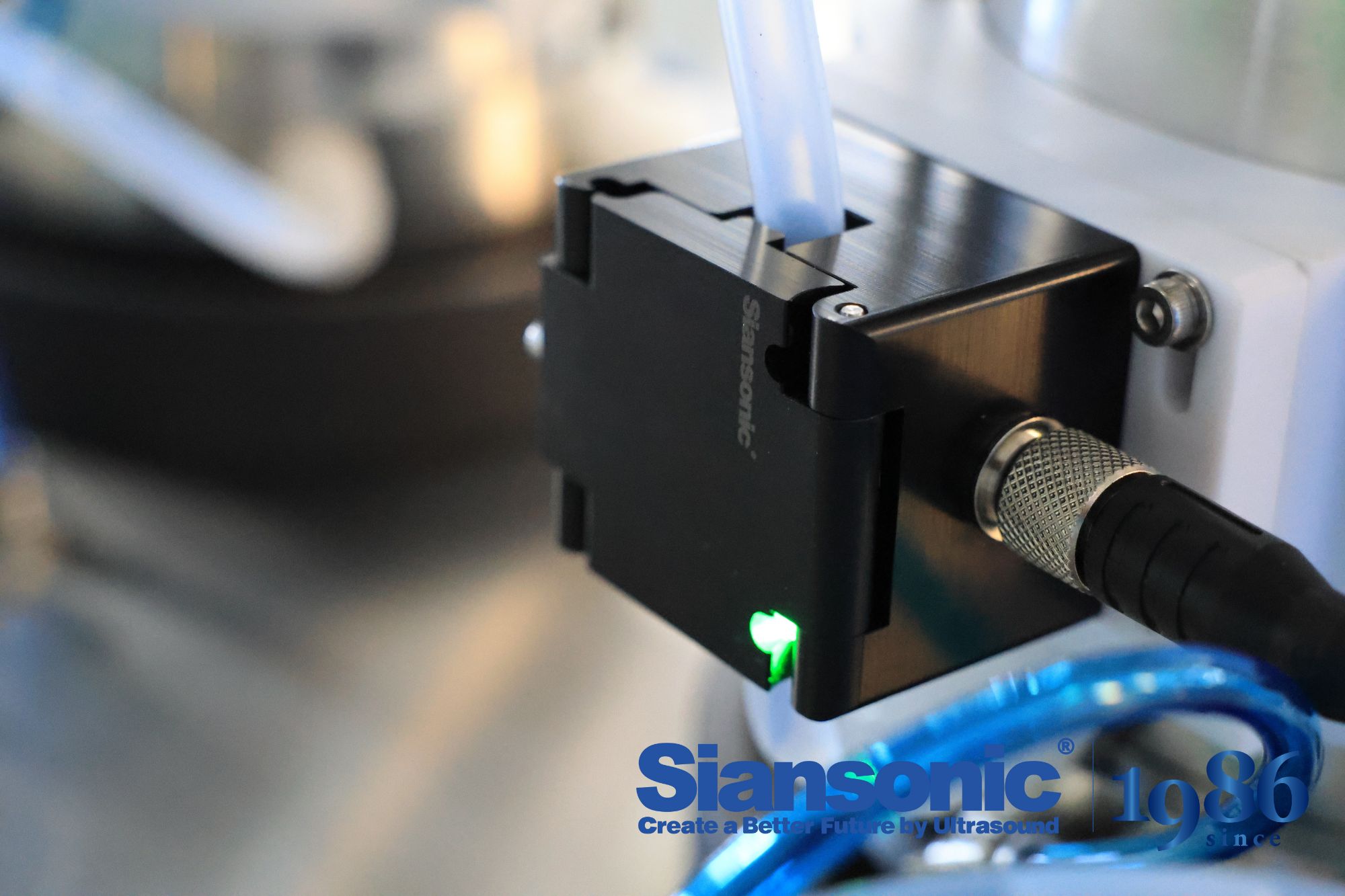
After months of routine wiping and the occasional deeper clean, small things start to shift. A lens barrel picks up micro-scratches that scatter a little more light. A sensor window holds onto a faint film even when it looks clear. None of this reads as a sudden fault, but together it changes how the instrument interprets what it sees.
Wide temperature swings work on the hardware in a different way. Joints that were snug at installation loosen slightly after repeated expansion and contraction. Internal references move, sometimes by only a few microns, but enough to tilt a baseline. The effect often shows up first as a seasonal drift: numbers run slightly high in cold months, then settle back, until one day the offset no longer returns to zero.
That is why long-term accuracy is less about one perfect calibration and more about watching the trend. A unit that gets cleaned often and lives in an unstable room may still hold most of its original performance, but the useful tolerance band narrows. Checking it against a fixed standard every few months makes the difference between catching a gentle drift and discovering a major error after it has already affected the work.
Will the Sensor Still Perform When Your Fluid Isn't Water?
Most sensor datasheets quote performance in clean water, but that figure is only a starting point once the actual fluid changes. Viscosity, dielectric constant, thermal conductivity, and even dissolved solids can shift response time, accuracy, and signal strength in ways that are easy to miss until readings begin to drift in the field.
A sensor that relies on thermal dispersion may respond more slowly in oil or glycol because heat moves away from the sensing element differently. Capacitive level probes can read differently in solvents with a low dielectric constant, while conductivity-based sensors may fail entirely in ultrapure water or nonpolar fluids. The problem is not always a sudden failure; sometimes the output simply becomes less repeatable or slower to settle.
Before moving a water-rated sensor into another fluid, check whether the manufacturer can provide reference data for your actual medium. If not, a short bench test against a known standard is usually cheaper than discovering the mismatch after installation. Small differences in fluid behavior can matter more than the sensor's headline specifications.
Who Answers You After the Purchase Order Is Signed?
Once the ink dries on the purchase order, you're not left guessing who to call. Most companies assign a dedicated account manager or customer service representative, but the real answer varies depending on the vendor's size and structure. In smaller shops, the salesperson who negotiated the deal often stays your main contact through delivery and beyond. In larger organizations, you might be handed off to a post-sales coordinator who tracks inventory, schedules shipments, and handles any hiccups with the order.
A practical move is to ask for this before signing. Reputable suppliers will clearly name the person responsible for your account and give you direct contact details—not just a generic support email. If the answer sounds vague, like "the team will handle it," that's a red flag worth probing. You want someone who knows your order specifics without having to re-explain everything each time you reach out.
After the order is placed, the most reliable contacts are usually those with access to real-time order status, warehouse inventory, and dispatch schedules. They should be able to tell you whether your goods are still on the dock or already on a truck. If a vendor can't answer that simple question within a day, it often signals a breakdown in internal communication—something you'll feel directly when deadlines slip.
Are They Willing to Share Real Failure Rates and Field Returns?
Some suppliers treat real quality data as a bargaining chip rather than a disclosure. They might mention a vague “high reliability” figure or a carefully chosen snapshot, but stop short of showing failure rates by production lot, region, or year. That hesitation often says more than a datasheet would.
Others make the raw numbers part of the conversation early. A supplier that is comfortable sharing DPPM rates, field return percentages, and the split between manufacturing defects and application-related damage usually has a traceability system behind those figures. The most useful disclosures don’t just give an average; they show distribution over time and explain what changed after a spike.
It is also worth pressing on how field returns are classified. A low return rate can be manufactured by counting no-fault-found units separately or by excluding certain failure modes. Asking for the definitions and the failure analysis summaries reveals whether the supplier is sharing a meaningful picture or just protecting a number.
How Much Room Is There to Adjust Sensitivity as Your Process Evolves?
In practice, sensitivity adjustments are rarely a one-time decision. Early on, a process might benefit from tighter thresholds because variability is still being characterized, but as equipment beds in and operator habits stabilize, those same thresholds can start generating nuisance alerts. The room to adjust depends on whether the original limits were set around a nominal target or derived from actual process capability. If the margin between the control limits and the specification limits is wide, there is generally more flexibility to shift sensitivity without risking false accepts or false rejects. If that margin is thin, even a small change can push the system into a region where it is either too forgiving or too jumpy.
A practical way to gauge available headroom is to track the distribution of recent measurements rather than relying on a fixed setpoint. When the process center drifts slightly or the spread narrows after a raw material change, the sensitivity can be retuned to reflect the new normal. The key is to make those adjustments in small, documented steps and compare the resulting alert rate against actual defects found downstream. If a sensitivity increase does not surface more real issues, the process may not have much usable signal left at that measurement point, and the better move may be to look at a different variable altogether.
FAQ
Look for a supplier that can walk through specific cases, such as identifying microbubbles in high-viscosity fluids or maintaining a stable signal during pressure swings. A partner with field-proven adaptations is usually more valuable than one that only quotes a standard datasheet.
Ask about batch-level testing, calibration tolerances, and what data is captured before shipping. Reliable suppliers track parameters like sensitivity drift and response time across individual units, not just on the reference design.
The answer should cover more than ideal conditions. A strong supplier explains how the sensor handles shifts in viscosity, temperature, or acoustic properties, and whether any compensation is built into the signal path or handled through calibration.
A trustworthy partner provides representative data from lifetime tests, repeatability runs, or customer evaluation units without hiding behind a non-disclosure wall. This lets you compare performance against your own pass/fail criteria early.
The supplier should be clear about what can be adjusted, such as housing material, cable length, output format, or detection thresholds, and which changes require a full redesign. Fast-turn sample runs are a good sign of mature processes.
You want formal change notification, version control, and enough lead time to revalidate. The supplier should be able to explain their revision policy and show that backward compatibility is taken seriously.
A reliable partner offers more than a replacement. They should describe how returned units are inspected, what failure modes are tracked, and how findings feed back into process control or design updates.
Check whether the supplier maintains buffer stock for critical components, has multiple qualified assembly lines, and can commit to realistic lead times. Their answer reveals whether they are set up to support production scaling or only small-volume projects.
Conclusion
A supplier's brochure rarely tells you whether the sensor will detect the bubbles your process actually makes. Ask for test data that matches your own bubble size distribution, line pressure, flow velocity, and fluid behavior instead of relying on a clean-water demo. It also matters how sensitivity drifts after months of CIP cycles, autoclaving, or repeated temperature swings, and whether the unit still responds predictably when the liquid is not water. Many processes generate irregular, fast-moving, or very small bubbles that behave nothing like the ideal spheres shown in a lab setup. If the supplier cannot show raw signal traces from conditions close to yours, that gap will eventually show up on your line.
Just as important is the relationship after the order is signed. Find out who answers technical questions, whether the supplier will share genuine field return rates and failure data, and how honestly they talk about known limitations. A dependable partner will not hide behind a generic support ticket; they will walk through your process changes and adjust sensitivity, filtering, or mounting guidance without treating every request as a new sale. That flexibility matters because bubble size, fluid viscosity, and line speed rarely stay static over the life of the equipment.
Contact Us
Contact Person: Ivy Zhang
Email: [email protected]
Tel/WhatsApp: +86 1081502288
Website: https://www.siansonic.com/